Intra Cytoplasmic Sperm Injection (ICSI)
ICSI Treatment in Karimnagar
How Fertilisation Normally Happens, and Where It Can Go Wrong
In a natural cycle, a single sperm has to make its way through the outer shell of the egg (called the zona pellucida) and fuse with it to trigger fertilisation. But when sperm quality is low, egg numbers are limited, or there's simply a poor interaction between the two, this natural process can fail, even inside a lab setting. That's where assisted reproduction steps in, offering two main routes: conventional IVF and Intracytoplasmic Sperm Injection, better known as ICSI.
Conventional IVF: Letting Nature Take the Lead
In conventional IVF, after the eggs are retrieved, each one is placed in a culture dish along with a concentrated sample of sperm, allowing fertilisation to happen much as it would naturally, just outside the body. This works well when both egg and sperm quality are reasonably good.
ICSI: A More Direct Approach
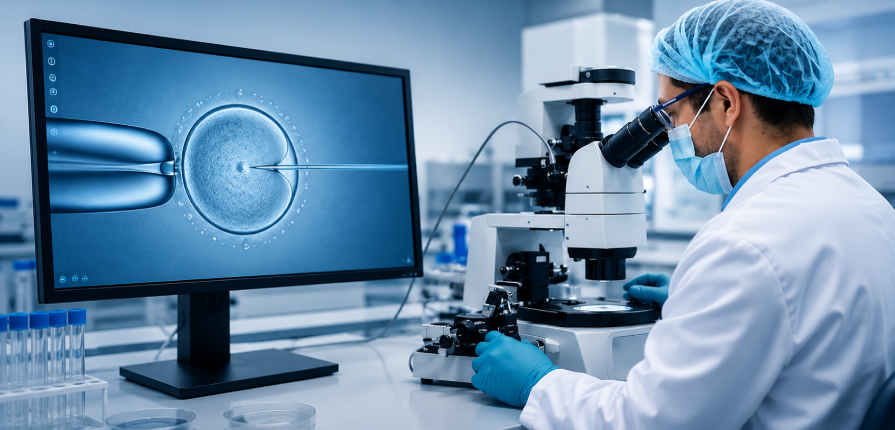
ICSI takes a more hands-on approach. Using a high-precision micromanipulation set-up, a specialised microscope paired with micro-injectors, our embryologists select a single, healthy-looking sperm and inject it directly into the egg. Because it bypasses many of the natural barriers to fertilisation, ICSI has become the preferred technique in a large number of IVF cycles worldwide, particularly where semen quality is a concern. Fertilisation is checked the following day under the microscope.
Where ICSI Has Its Limits
While ICSI closely mimics what would naturally happen in the fallopian tube, it isn't a guarantee. It cannot correct every underlying issue with how sperm and egg interact, so outcomes can still vary from cycle to cycle, and success isn't assured every time.
Who Should Consider ICSI?
Both conventional IVF and ICSI are used for similar underlying conditions: tubal issues, uterine factors, diminished ovarian reserve, ovulatory disorders, endometriosis, and unexplained infertility. ICSI specifically becomes the recommended path when semen analysis shows a low sperm count or poor motility, when only a small number of eggs are available, or when a previous IVF cycle didn't result in fertilisation. Conventional IVF, on the other hand, tends to be reserved for couples where both partners' fertility indicators look favourable.
Frequently Asked Questions
These techniques were originally developed for blocked or missing fallopian tubes, and are now also used for endometriosis, male-factor infertility, and unexplained infertility. Our specialists at Rekha Sagar Fertility Centre in Karimnagar will review your history to recommend the most suitable path forward.
ICSI is performed during an IVF cycle, which involves ovarian stimulation, monitoring, egg retrieval, sperm preparation, fertilisation and embryo transfer. The overall timeline varies depending on the treatment protocol and individual response.
ICSI is not a separate alternative to IVF. It is a fertilisation technique commonly performed as part of an IVF cycle. The main difference is how the egg is fertilised in the laboratory.
ICSI can help overcome certain fertilisation difficulties by directly injecting a selected sperm into a mature egg. It can be particularly useful in cases involving significant male-factor infertility or previous fertilisation problems.
ICSI may be considered when previous IVF cycles have resulted in poor or failed fertilisation, particularly when sperm-related factors are suspected. A detailed review of previous treatment helps determine the next approach.
Book Your Appointment
If you and your partner are considering ICSI or other fertility treatments, Rekha Sagar IVF & Research Center is here to provide personalized fertility care and guidance. Our experienced team offers comprehensive fertility evaluation, ICSI treatment, and supportive care tailored to your individual needs.
Call +91 949 070 4277 or book an appointment for a confidential consultation and take the next step towards building your family.