Gynaecology
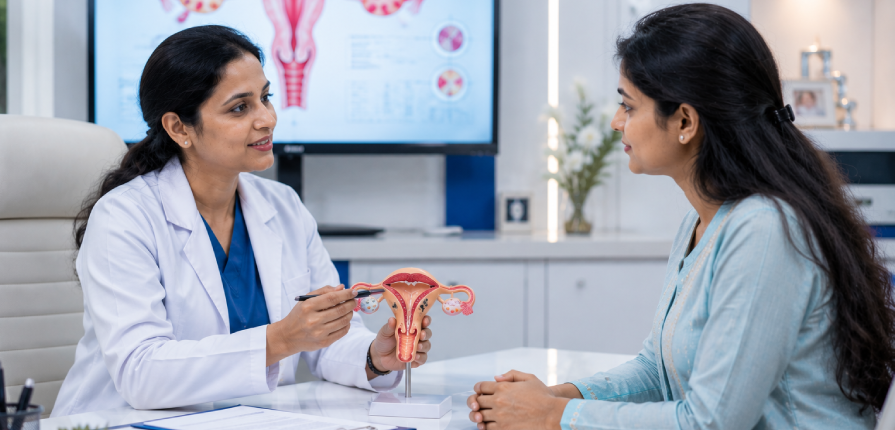
Gynaecology Services in Karimnagar
Gynaecological problems rarely feel simple when you are the one living with them - whether that is heavy periods disrupting your month, pain you cannot quite explain, or a diagnosis you were not expecting. Dr. Rekha Rani treats the full range of gynaecological conditions for women in Karimnagar and the surrounding districts at Rekha Sagar IVF & Research Center, with a strong preference for keyhole and minimally invasive techniques wherever they can safely replace open surgery. Below is an overview of the areas she manages most often.
Conditions of the Uterus
Fibroids and Myomectomy
Fibroids are non-cancerous growths in the uterus that can cause pelvic pressure, frequent urination, heavy periods, and in some cases difficulty conceiving. Rather than removing the uterus outright, a myomectomy removes just the fibroids through keyhole surgery, preserving the uterus and shortening recovery time compared to open surgery. Dr. Rekha Rani has managed cases involving multiple fibroids in a single uterus.
Hysterectomy
When the uterus itself needs to be removed, there is more than one way to do it. A laparoscopic hysterectomy uses small keyhole incisions to remove the uterus and fallopian tubes while leaving the ovaries in place, and is generally preferred for its faster recovery. An abdominal hysterectomy, done through a single open incision, remains the right choice in certain cases depending on uterine size or other medical factors. Which approach fits best is decided after a proper clinical assessment.
Hysteroscopy
A hysteroscope, a thin telescope-like instrument, is passed through the cervix to examine the inside of the uterus directly. It is used both to diagnose causes of abnormal bleeding and, when needed, to treat polyps, fibroids, or scar tissue found during the same procedure. Read more on our dedicated Hysteroscopy in Karimnagar page.
Pelvic Floor and Prolapse
Prolapse surgery
When the uterus, bladder, or bowel shifts down into the vaginal canal - a condition known as prolapse - it can be corrected through a vaginal approach, a laparoscopic approach, or a combination of the two depending on severity. For more advanced prolapse, a laparoscopic sacrocolpopexy offers a durable, minimally invasive correction that typically needs only one to two days in hospital, with recovery over two to three weeks.
Incontinence surgery
Stress incontinence, the leakage of urine while coughing, sneezing, laughing, or exercising, is a common but often unspoken problem that does not need to be lived with. Procedures such as the sub-urethral tape (TVT) or laparoscopic colposuspension resolve this in the majority of cases and can meaningfully change day-to-day life.
Ovarian and Tubal Conditions
Adnexal surgery
Cysts and tumours affecting the ovaries and fallopian tubes are, in most cases, well suited to laparoscopic management, avoiding the need for a larger incision.
Laparoscopic sterilization
For women who have completed their families and want a permanent method of contraception, this procedure blocks the fallopian tubes through a keyhole approach.
Endometriosis
Endometriosis develops when tissue similar to the uterine lining grows outside the uterus - on the ovaries, tubes, pelvic lining, and occasionally the bowel or bladder. It can cause painful periods, pain during intercourse, heavy bleeding, discomfort passing stool, and difficulty conceiving. Proper treatment means fully excising the disease through keyhole surgery to restore normal pelvic anatomy, not simply cauterising the surface of visible deposits, which leaves the underlying disease behind. This distinction matters, and it is why endometriosis surgery is best handled by a surgeon with specific experience in the condition.
Diagnostic and Minor Procedures
Colposcopy: When a cervical screening test shows an abnormality, colposcopy allows a closer, magnified examination of the cervix, with a biopsy taken if needed to confirm what is going on.
Cervical procedures: Cryocauterization and LLETZ are used to treat cervical erosions and related changes, while cervical conization addresses more significant cervical dysplasia identified on biopsy.
Other Procedures Performed at the Centre
Beyond the major categories above, Dr. Rekha Rani also performs a wide range of established gynaecological procedures, including:
- Non-descent vaginal hysterectomies and total abdominal hysterectomies
- Tuboplasty and tubal recanalisation
- Sling surgeries for incontinence
- Ovarian cystectomy and ovariectomy for ovarian pathology
- Strassmann’s metroplasty for bicornuate uterus
- Fothergill’s (Manchester) surgery for nulliparous descent
- Complete colpocleisis for vault prolapse
- Ward Mayo’s surgery for vaginal prolapse
- Cystocele and rectocele repair
- Thermal endometrial balloon ablation for abnormal uterine bleeding
- MIRENA insertion for abnormal uterine bleeding
Getting the Right Diagnosis First
Because many gynaecological symptoms - heavy bleeding, pelvic pain, pressure - can point to several different underlying causes, the starting point is always a careful clinical evaluation, often supported by ultrasound or other targeted tests. From there, Dr. Rekha Rani discusses the options honestly, including which procedures can be done through keyhole surgery, what recovery will look like, and what makes sense for your specific situation and future plans, including fertility if that is a consideration. Women travelling to Karimnagar from Jagitial, Peddapalli, and Ramagundam for a second opinion are welcome to bring existing scans and reports to the first visit.
Frequently Asked Questions
Not every gynaecological condition requires surgery. Many cases of fibroids, hormonal imbalance, or mild endometriosis can be managed medically first. Surgery is recommended only when it is genuinely the better option for your symptoms, fertility plans, or long-term health.
In most cases, yes - but it depends on factors like uterine size, the extent of the disease, and your overall health. Dr. Rekha Rani will assess this during your consultation and explain clearly if an open procedure is medically necessary instead.
Recovery is typically much faster than open surgery - most women return to light routine within one to two weeks, compared to four to six weeks after an open procedure, though this varies by the specific surgery performed.
Many of the procedures listed above, including myomectomy and endometriosis excision, are specifically performed in ways that preserve fertility. This is always discussed as part of your treatment plan if having children is a future consideration.
No referral is needed. You can book a direct consultation for any gynaecological concern.
Book Your Consultation
If you are dealing with a gynaecological concern, big or small, book your consultation at Rekha Sagar IVF & Research Center, Karimnagar. Call +91 949 070 4277 to get a clear, honest assessment of your options.